Building a Strategic Gateway for Open-Minded Debate
.png)
Open To Debate
A mission-driven website designed to introduce Open to Debate, build trust, and intentionally transition users to their Substack ecosystem.
Open To Debate
2025
New York, USA
About the Project
Open to Debate (formerly Intelligence Squared US) is a leading nonprofit platform dedicated to fostering open-minded, balanced debate on the most important issues of our time.
Following their rebrand, they needed more than a visual refresh, they needed a strategic digital foundation that clarified:
- Their mission and methodology
- Their credibility and heritage
- Their new positioning
- Their multiple distribution platforms, and new primary content destination: Substack
The project was completed in an accelerated 2-month timeline, structured into four focused phases:
Discovery & Strategy
We began with a comprehensive Discovery & Strategy process, delivering a detailed strategy deck outlining:
- Competitive and category benchmarks
- Audience personas
- Key user journeys
- Messaging hierarchy
- Proposed information architecture
- Homepage content structure
- Cross-platform integration strategy
This phase clarified a critical insight: the website was not the final destination, it was a strategic gateway.
The Core Challenge: Designing for Exit
Unlike most websites, where the goal is to maximize time-on-site, Open to Debate had a different objective.
They wanted users to:
- Land on the website
- Quickly understand who they are
- Build trust and credibility
- Then transition to their platform of choice, including Substack, where most debates, newsletters, and engagement occur
This required a carefully engineered experience.
The website needed to:
- Be compelling but not overwhelming
- Build authority without content overload
- Create clarity, not friction
- Guide users outward at the right moment
We designed intentional frictionless exits through:
- Persistent Platform CTAs
- Modular homepage blocks
- Clear debate previews with outbound pathways
- Reinforced cross-platform messaging
The result: a site that performs as a high-conversion introduction layer.
.png)
Translating Strategy into Structure
We developed a streamlined IA designed around clarity and conversion.
The architecture prioritized:
- Mission-first storytelling
- Clear credibility signals
- Modular content blocks
- Multiple engagement pathways
This structure ensured that first-time visitors could orient themselves within seconds.
.png)
UX/UI Design
With the IA validated, we moved into:
Defining the Visual Direction
With the information architecture established, we partnered closely with the Open to Debate team to define the visual direction that would bring the strategy to life.
The goal wasn’t simply to modernize the brand, it was to align the design with their mission: fostering open-minded, balanced debate in a polarized media landscape.
Together, we explored how the platform should feel:
- Authoritative, but accessible
- Editorial, but institutional
- Serious, but human
We defined a visual system rooted in:
- Mission-forward typography
- Structured, editorial layouts
- High-quality debate photography
- Clear, repeatable call-to-action patterns
- A balanced, credibility-driven color hierarchy
Every design decision reinforced trust, clarity, and intellectual rigor, ensuring the website felt like a natural extension of Open to Debate’s debates, Substack presence, and live events.
This shared direction became the foundation for the high-fidelity prototypes that followed.
.png)
Wireframing
- Layout prioritization
- Content hierarchy
- CTA positioning
- Modular homepage logic
Then into:
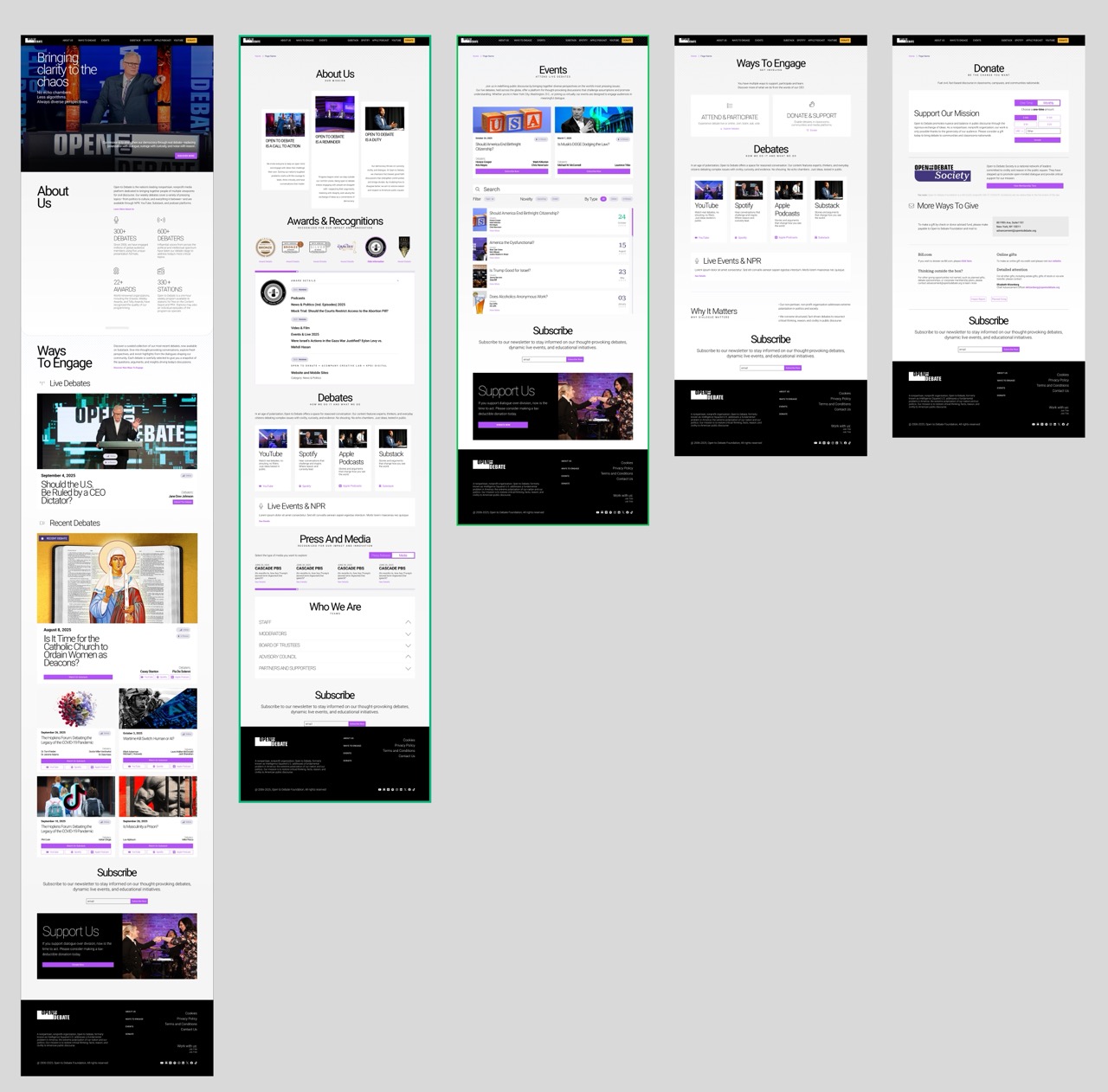
High-Fidelity Prototyping
- Editorial-forward design language
- Strong, rallying hero messaging
- Balanced typography for intellectual credibility
- Modular debate previews
- Integrated Substack, YouTube, and podcast prompts
Every design decision reinforced the central strategic principle:
Build authority. Then guide outward.
Implementation & QA
The final phase focused on:
- Development of a modular, scalable CMS structure
- Flexible homepage blocks for frequent updates
- Clean editorial layouts optimized for readability
- Strategic CTA repetition across pages
- Performance optimization
- Cross-device QA
- Accessibility considerations
The backend was structured to allow the Open to Debate team to easily:
- Update featured debates
- Highlight upcoming events
- Add press mentions
- Adjust homepage priorities
All without compromising clarity.
What Impact Looks Like
In just two months, we delivered:
- A fully reimagined brand-aligned website
- Clear articulation of mission and methodology
- A simplified user journey aligned with real behavior
- Modular infrastructure for long-term growth
- Strategic alignment between site, Substack, YouTube, podcast platform, and donation flows
Most importantly, Open to Debate now has a digital foundation that:
- Introduces their mission with clarity
- Establishes authority instantly
- And intentionally moves audiences toward deeper engagement
This wasn’t simply a redesign.
It was the strategic alignment of brand, platform, and ecosystem.